There are some gifts we only truly appreciate when they are in danger of disappearing. Water is one of them. Our appreciation and realisation of that have been heightened by the exceptionally dry Summer we have just experienced. We turn on a tap and expect clean water to flow. We see rain falling and perhaps complain about the weather. We walk beside a river without always thinking about the life it sustains. Yet water is at the heart of life itself. Without it, there can be no flourishing of people, animals, plants or communities.
It is fitting, then, that the theme of the Season of Creation 2026 is “Living Water.” Beginning on 1 September, the World Day of Prayer for the Care of Creation, and continuing until 4 October, the Feast of St Francis of Assisi, this annual season invites Christians to pray, reflect and act for the care of our common home.
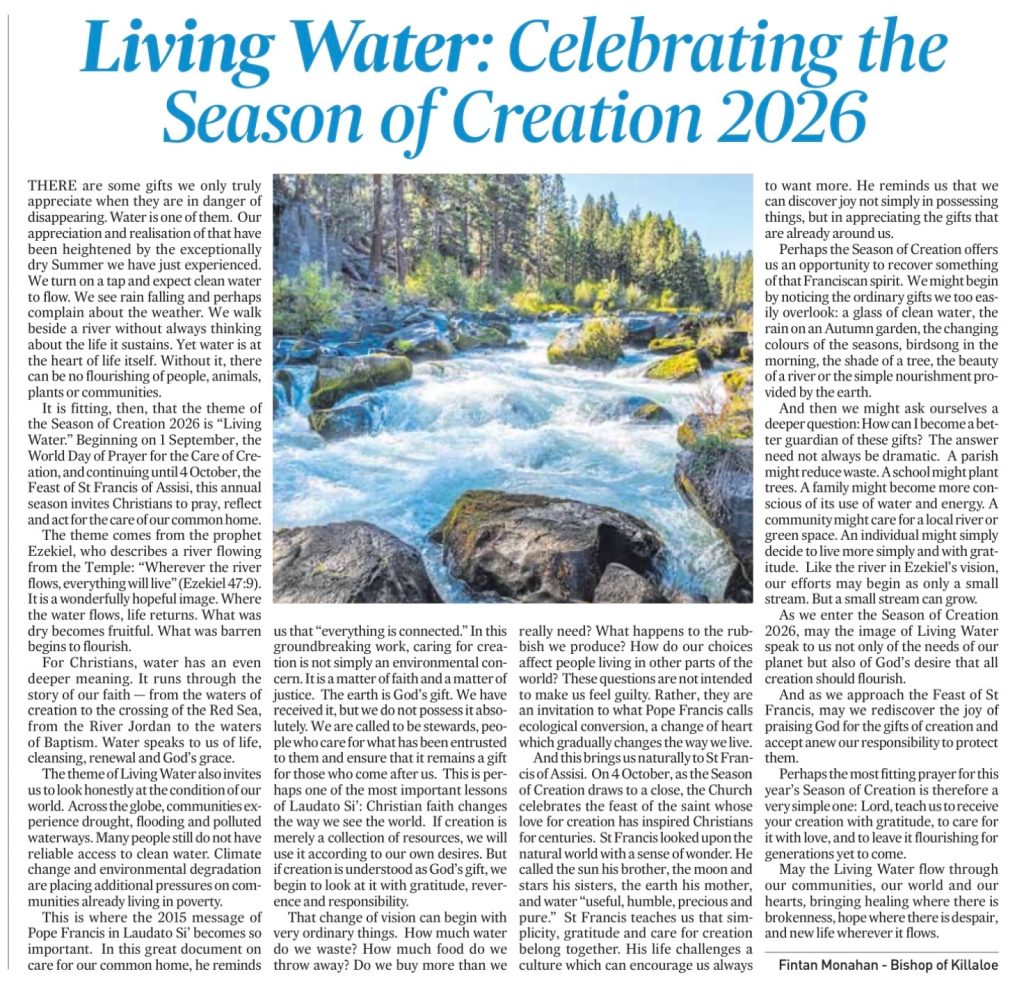
The theme comes from the prophet Ezekiel, who describes a river flowing from the Temple: “Wherever the river flows, everything will live” (Ezekiel 47:9). It is a wonderfully hopeful image. Where the water flows, life returns. What was dry becomes fruitful. What was barren beginning to flourish.
For Christians, water has an even deeper meaning. It runs through the story of our faith — from the waters of creation to the crossing of the Red Sea, from the River Jordan to the waters of Baptism. Water speaks to us of life, cleansing, renewal and God’s grace.
The theme of Living Water also invites us to look honestly at the condition of our world. Across the globe, communities experience drought, flooding and polluted waterways. Many people still do not have reliable access to clean water. Climate change and environmental degradation are placing additional pressures on communities already living in poverty.
This is where the 2015 message of Pope Francis in Laudato Si’ becomes so important. In this great document on care for our common home, he reminds us that “everything is connected.” In this groundbreaking work, caring for creation is not simply an environmental concern. It is a matter of faith and a matter of justice. The earth is God’s gift. We have received it, but we do not possess it absolutely. We are called to be stewards, people who care for what has been entrusted to them and ensure that it remains a gift for those who come after us. This is perhaps one of the most important lessons of Laudato Si’: Christian faith changes the way we see the world. If creation is merely a collection of resources, we will use it according to our own desires. But if creation is understood as God’s gift, we begin to look at it with gratitude, reverence and responsibility.
That change of vision can begin with very ordinary things. How much water do we waste? How much food do we throw away? Do we buy more than we really need? What happens to the rubbish we produce? How do our choices affect people living in other parts of the world? These questions are not intended to make us feel guilty. Rather, they are an invitation to what Pope Francis calls ecological conversion, a change of heart which gradually changes the way we live.
And this brings us naturally to St Francis of Assisi. On 4 October, as the Season of Creation draws to a close, the Church celebrates the feast of the saint whose love for creation has inspired Christians for centuries. St Francis looked upon the natural world with a sense of wonder. He called the sun his brother, the moon and stars his sisters, the earth his mother, and water “useful, humble, precious and pure.” St Francis teaches us that simplicity, gratitude and care for creation belong together. His life challenges a culture which can encourage us always to want more. He reminds us that we can discover joy not simply in possessing things, but in appreciating the gifts that are already around us.
Perhaps the Season of Creation offers us an opportunity to recover something of that Franciscan spirit. We might begin by noticing the ordinary gifts we too easily overlook: a glass of clean water, the rain on an Autumn garden, the changing colours of the seasons, birdsong in the morning, the shade of a tree, the beauty of a river or the simple nourishment provided by the earth.
And then we might ask ourselves a deeper question: How can I become a better guardian of these gifts? The answer need not always be dramatic. A parish might reduce waste. A school might plant trees. A family might become more conscious of its use of water and energy. A community might care for a local river or green space. An individual might simply decide to live more simply and with gratitude. Like the river in Ezekiel’s vision, our efforts may begin as only a small stream. But a small stream can grow.
As we enter the Season of Creation 2026, may the image of Living Water speak to us not only of the needs of our planet but also of God’s desire that all creation should flourish.
And as we approach the Feast of St Francis, may we rediscover the joy of praising God for the gifts of creation and accept anew our responsibility to protect them.
Perhaps the most fitting prayer for this year’s Season of Creation is therefore a very simple one: Lord, teach us to receive your creation with gratitude, to care for it with love, and to leave it flourishing for generations yet to come.
May the Living Water flow through our communities, our world and our hearts, bringing healing where there is brokenness, hope where there is despair, and new life wherever it flows.
Fintan Monahan – Bishop of Killaloe
Clare Champion Article, Friday, 4th of September
Screenshot